
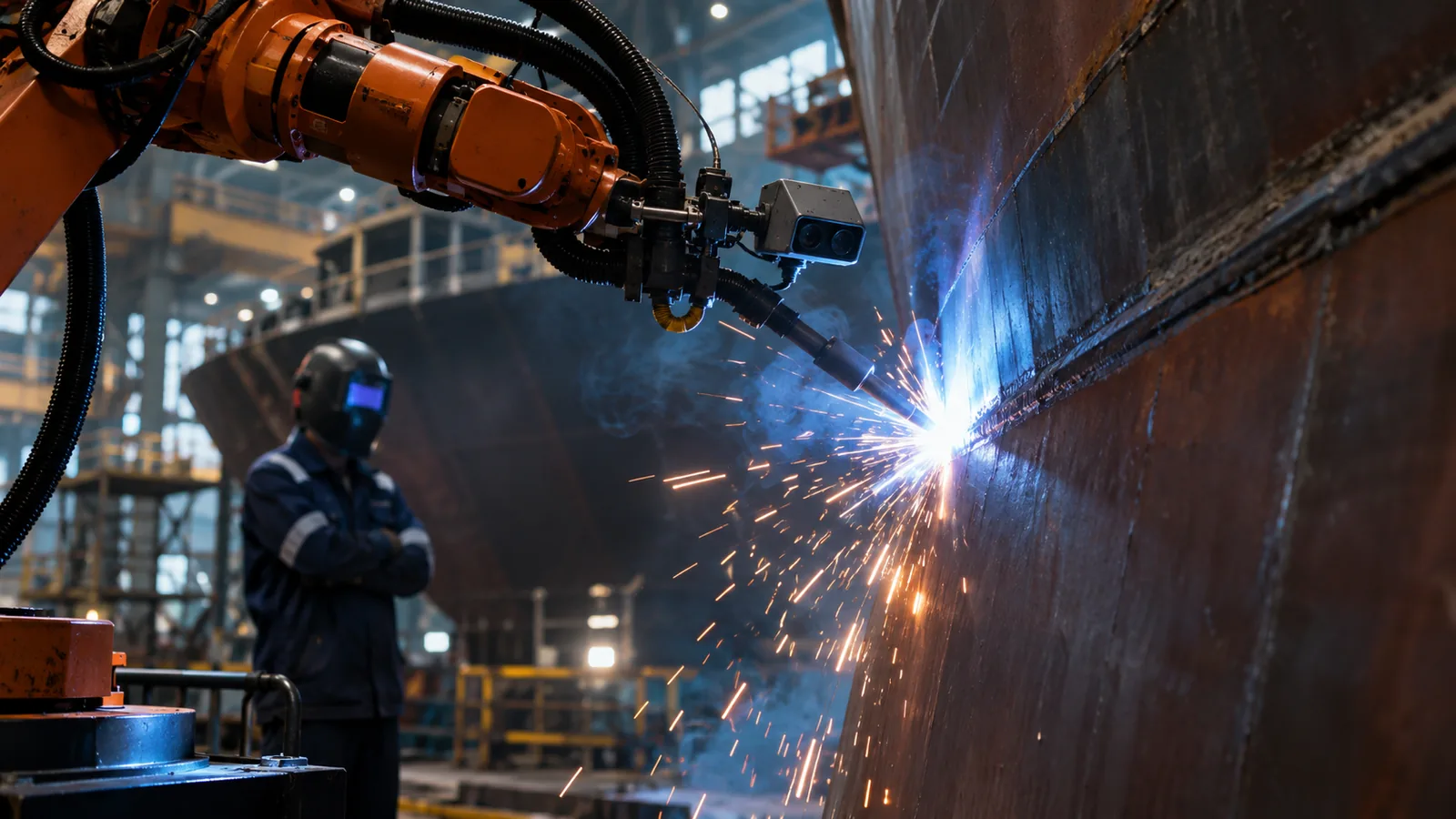
Chinese welding robots are the first "embodied AI" machines doing paid industrial work at scale in 2026. In July, Beijing startup Xiaoyu Zhizao launched what it calls the first embodied-AI welding robot for industrial production, priced from RMB 169,800 (about $23,400) and already working in more than ten factories. A wall-climbing dual-arm welder and a 30-ton offshore welding system went into service the same year. Here is what these machines really do, what they cost, and what they mean for US shops and welders.
👉 Bottom line: China's welding robots went viral in 2026 because they removed the two things that kept welding manual: expensive programming and seven-figure cells. Most are AI-guided arms, not walking humanoids.
- The headline robot: Xiaoyu Future, launched July 2, 2026, installs in about four hours, is programmed by pointing a pen at the seam, and costs from $23,400.
- The humanoid one: RobotPlusPlus's 90 kg dual-arm robot climbs steel walls on a magnetic chassis and grinds with one hand while welding with the other.
- The heavy one: CNOOC's offshore system welds steel up to 70 mm thick with a 98%+ first-pass qualification rate.
- Why China: it installed 354,000 industrial robots in 2025, 59% of the world total, and its welders average over 45 years old.
- For US buyers: on October 30, 2026 the White House declined new Section 232 tariffs on robots, but ordered 180 days of trade talks, so the door can still close.
What Are Chinese "Embodied AI" Welding Robots?
A classic welding robot repeats a path someone programmed by hand. That works for a car plant welding the same door a million times. It fails in a shipyard or a steel fabricator, where every part is different.
The 2026 Chinese wave adds three things on top of a standard arm: 3D vision that finds the seam on its own, an AI model trained on real welding data that plans the passes, and programming so simple a welder can do it without code. "Embodied AI" is the marketing label for that combination of perception, a learned model and a physical body.
- Perception: 3D cameras or laser scanners build a point cloud of the joint, so small fit-up errors do not ruin the weld.
- Planning: the model chooses the torch path, layers and passes, including multi-pass welds on thick plate.
- Correction: trajectory is adjusted in real time as the metal heats and moves.
- Body: usually a cobot or industrial arm; in a few cases a dual-arm humanoid upper body on a crawler or magnetic base.
👉 Key point: the breakthrough is not the arm, which is a commodity. It is cutting programming time to near zero, which finally makes robots pay off on one-off and small-batch work.
The 3 Chinese Welding Robots Everyone Talked About in 2026
1. Xiaoyu Future (Xiaoyu Zhizao, Beijing)
Unveiled on July 2, 2026 at the Global Digital Economy Conference in Beijing, the Xiaoyu Future is billed as the industry's first embodied-AI welding robot. Xinhua reported it was already in use at more than ten factories in shipbuilding, steel structures and bridge building.
The build is a smart mix of global parts: a Universal Robots collaborative arm (about 0.5 mm absolute accuracy), Mech-Mind welding 3D cameras and an NVIDIA Orin computer. The secret sauce is the "Runwu" world model, trained on more than 100,000 hours of welding-site data, and a handheld "pointer pen": you touch the seam, the robot plans the weld.
- Price: from RMB 169,800 (≈ $23,400) for the standard workstation.
- Install: about four hours, against weeks for conventional automation.
- Named user: China Construction Steel Structure.
- Developer access: an open SDK under a free commercial license.
“Industrial settings are controllable and are a likely proving ground for generalized embodied intelligence.”
— Qiao Zhongliang, founder and CEO of Xiaoyu Zhizao, as summarized by Embodied Global
2. The wall-climbing humanoid welder (RobotPlusPlus, Zhejiang)
This is the robot behind the viral clips. CGTN called it China's first embodied intelligent humanoid robot for high-risk industrial tasks when it entered service in April 2026 on a chemical storage tank site.
It has a 15-degree-of-freedom humanoid upper body, weighs about 90 kg and sticks to vertical steel with an electromagnetic wheeled chassis. Swap the end-effector and it moves from welding to flaw detection, rust removal or spraying. An operator in a control room can steer it with VR glasses, and Xinhua reported that its model has logged over 100,000 hours of operation.
In July it was shown again in Beijing, welding on vertical walls of tanks, ships and energy facilities.
3. CNOOC's offshore welding system (Tianjin)
The least viral but most impressive. Offshore Oil Engineering Co., part of CNOOC, put China's first domestically developed intelligent welding system for marine engineering into service in June 2026. It took about 10 months of on-site debugging and nearly 1,000 welding experiments.
- Handles parts up to 30 tons and steel up to 70 mm thick.
- First-pass qualification rate above 98%.
- Overall efficiency over 40% higher than traditional welding.
- Designed service life of 20 years, with 100% domestic software and process libraries.
💡 Unique insight: all three robots target high-mix, heavy, ugly work: ships, tanks, bridges, platforms. That is the exact segment Western automation skipped for 30 years because programming each part cost more than paying a welder.
Quick comparison
| Robot | Form | Best for | Key number | Status |
|---|---|---|---|---|
| Xiaoyu Future | AI cobot workstation | Steel structures, bridges, ship parts | From $23,400 | 10+ factories |
| RobotPlusPlus special-ops robot | Dual-arm humanoid on magnetic chassis | Vertical tanks, hulls, hazardous sites | 90 kg, 15 DoF | In service since April 2026 |
| CNOOC marine welding system | Heavy gantry/robot cell | Offshore platform nodes, jackets | 30 t, 70 mm steel, 98%+ pass | In service since June 2026 |
| Estun, Efort, Inovance arc arms | 6-axis industrial arm | Production welding lines | 6 kg payload, ±0.05 mm | Mass-market |
Why China Is Automating Welding So Fast
China has roughly 10 million welders, and their average age is above 45, according to an August 2026 analysis. Young workers are not replacing them. Meanwhile China won 63% of global new shipbuilding orders in 2025 (1,421 ships, per Clarksons data), and ships are mostly welding.
The robot base is already there. The International Federation of Robotics says China installed 354,000 industrial robots in 2025, and Chinese suppliers took 55% of that market.
“China's success in modernising its industrial system is based on its national robotics strategy.”
— Jane Heffner, IFR President, World Robotics 2026 press release
Exports are rising too. A China Machinery Industry Federation report cited by the Global Times says Chinese industrial robot exports now exceed imports and reach 156 countries and regions.
- Labor: an aging welder workforce and a shipbuilding boom.
- Supply chain: cheap domestic arms, reducers, servos and cameras (see our humanoid robot stocks map of these suppliers).
- Data: real job sites generating 100,000+ hours of training data per model.
- Policy: a decade-long national robotics strategy and local subsidies.
✔ Takeaway: welding is where China's labor gap, its shipbuilding lead and its cheap robot hardware all meet. That is why it became the first real job for embodied AI.
Humanoid vs. Robot Arm: Which Welding Robot Actually Works?
Here is the part most viral videos skip. China produced about 12,800 humanoid robots in 2025 versus about 773,000 conventional industrial robots, and UBTech puts current humanoid productivity at roughly 30–40% of a human worker (Xpert.Digital, August 2026).
So the honest answer: for welding, the arm wins today. The humanoid shape only earns its place where an arm on a base cannot go, such as a vertical tank wall or the inside of a hull block.
| Factor | AI welding arm / cobot | Humanoid or dual-arm crawler |
|---|---|---|
| Weld quality | Proven, repeatable | Good on simple seams, still maturing |
| Reach | Fixed cell or cart | Climbs walls, enters tight spaces |
| Price | $23K–$75K for cobot packages | Mostly custom, not publicly priced |
| Setup | Hours to days | Site-specific, often teleoperated |
| Best use | Fabrication shops, ship parts | Hazardous, vertical, remote jobs |
Western players are betting on the humanoid form anyway. HD Hyundai is working with Persona AI on bipedal shipyard welders, with prototypes due by the end of 2026 and deployment from 2027. Tesla's own Optimus factory tasks are still far lighter than structural welding.
👉 Key point: if you see a "humanoid welding robot" clip, check the base. If it is on magnets or a crawler, it is a specialist machine. Legs on a shipyard floor are still a 2027+ story.
How Much Does a Chinese Welding Robot Cost in 2026?
Prices vary hugely by scope. A bare arm is cheap; integration, safety and tooling are where budgets go. The figures below are public list prices or published ranges, so always ask for a dated, itemized quote.
| Option | Example | Price range | Source |
|---|---|---|---|
| Chinese AI welding workstation | Xiaoyu Future | From RMB 169,800 (≈ $23,400) | Embodied Global |
| Cobot welding package | Cobot arm + torch + controller | $25,000–$75,000 (bare) | GrabaRobot |
| Dedicated industrial cell | Estun, Efort, Inovance or Japanese arm in a cell | $60,000–$250,000+ | GrabaRobot |
| Heavy custom system | Shipyard or offshore gantry cells | Custom, often seven figures | Industry quotes |
A simple payback scenario
The BLS median pay for US welders is $53,750 a year (May 2025). Add roughly 30% for payroll taxes and benefits and a welder costs a shop about $70,000.
If a $40,000 installed AI cobot takes over half of one welder's repetitive seams on a single shift, it saves about $35,000 a year and pays back in around 14 months. Run it on two shifts and payback drops under a year. This is our estimate, not a vendor claim; your weld mix and part prep decide the real number.
💡 Unique insight: the hidden cost is fixturing and part prep, not the robot. Chinese vision-guided systems shrink it, because the camera tolerates fit-up gaps that a blind taught path cannot.
Can US Shops Buy Chinese Welding Robots?
Yes, and for now without a new tariff. After a Section 232 national-security investigation, the President decided on October 30, 2026 not to impose Section 232 tariffs on robotics and industrial machinery. Commerce did find a threat, though, and trade talks must report back within 180 days, leaving tariffs, quotas or fees on the table.
Chinese-made robots also remain subject to the older Section 301 China tariffs, so confirm the current duty for your exact HTS code with a customs broker before you sign.
⚠️ Watch out: a cheap arm with no US service network can cost more than a pricier one. Downtime in a fab shop is measured in missed ship dates, not robot dollars.
7-step checklist before you buy
- Run a weld trial on your own parts, material and thickness, then cut and etch the samples.
- Check safety certification: look for third-party marks (the Xiaoyu arm carries TÜV Rheinland certification) and plan a risk assessment for your cell.
- Confirm US support: local integrator, spare-parts stock and guaranteed response time.
- Ask about software and data: does the AI need a cloud connection, and where does your part data go?
- Verify power source compatibility with your existing welders and consumables.
- Price the full scope: tooling, fixtures, fume extraction, guarding, training and delivery.
- Model tariff risk for the 180-day negotiation window and lock pricing in the contract.
What Chinese Welding Robots Mean for US Welders
Short version: they are arriving into a shortage, not a surplus. The American Welding Society projects the US will need about 320,500 new welding professionals by 2029, with roughly 80,000 jobs to fill each year and more than 157,000 welders nearing retirement.
BLS counts about 437,700 welder jobs in 2025 and around 40,300 openings a year through 2035. Robots will take the long, repetitive seams first. Fit-up, repair, field welding, inspection and robot programming stay human for years.
- At risk: repetitive production welding on long straight seams.
- Safe for now: pipe, field and repair welding, out-of-position work in tight spaces.
- Growing: robot welding operators, programmers, CWI inspectors and robot service techs (see our robot service technician career guide).
The smartest move for a welder in 2026 is to add a robotic credential, such as the AWS Certified Robotic Arc Welding program, on top of hands-on certs. More on this shift in our guide to how AI and robots are changing physical labor jobs.
✔ Takeaway: the welder who can teach, check and fix the robot becomes the most valuable person in the shop. The one who only runs straight beads faces the most pressure.
The Investing Angle
Most welding robot makers are private or buried inside large groups, so direct plays are thin. The listed exposure sits in the supply chain: AI compute like NVIDIA's Orin, precision reducers, servo makers and Chinese robot integrators.
For the humanoid side, see our breakdowns of UBTech stock and Unitree stock, the Harmonic Drive Systems reducer story and the full humanoid robot stocks list. This is not investment advice.
FAQ
What is the Chinese AI welding robot everyone is talking about?
Most likely the Xiaoyu Future by Beijing's Xiaoyu Zhizao, launched on July 2, 2026. It uses 3D vision and an AI world model trained on 100,000+ hours of welding data and starts at RMB 169,800 (about $23,400).
Is there a humanoid welding robot in China?
Yes. RobotPlusPlus's 90 kg dual-arm robot with a 15-DoF humanoid upper body climbs steel walls on a magnetic chassis and welds, grinds and inspects. It entered service in April 2026.
How much does a welding robot cost in 2026?
From about $23,400 for a Chinese AI workstation, $25,000–$75,000 for a cobot welding package and $60,000–$250,000+ for a dedicated industrial cell, before integration.
Are there tariffs on Chinese robots in the US?
No new Section 232 tariff: on October 30, 2026 the President chose talks instead, with a 180-day update. Existing Section 301 China tariffs can still apply, so check your HTS code.
Will welding robots replace welders?
Not soon. The US needs about 320,500 new welding professionals by 2029. Robots will take repetitive seams, while repair, field work, inspection and robot programming grow.
Summary
Chinese welding robots are the clearest sign in 2026 that embodied AI has left the demo stage. The viral humanoid clips grab attention, but the real shift is cheaper, vision-guided arms that a welder can program by pointing, installed in an afternoon for about $23,400.
China is automating welding first because it has the oldest welding workforce, the biggest shipbuilding order book and the cheapest robot supply chain. US shops can buy these machines today, but should test on their own parts, insist on local support and price in tariff risk while the 180-day trade talks run.
For welders, the message is not "you are replaced." It is "learn to run the robot." Bookmark this page: we update it as new Chinese welding robots, prices and US trade rules appear.
TRACKING ROBOTS AT WORK
We follow which robots are doing real industrial jobs in 2026, from Chinese welders to Tesla Optimus on the factory floor.
