
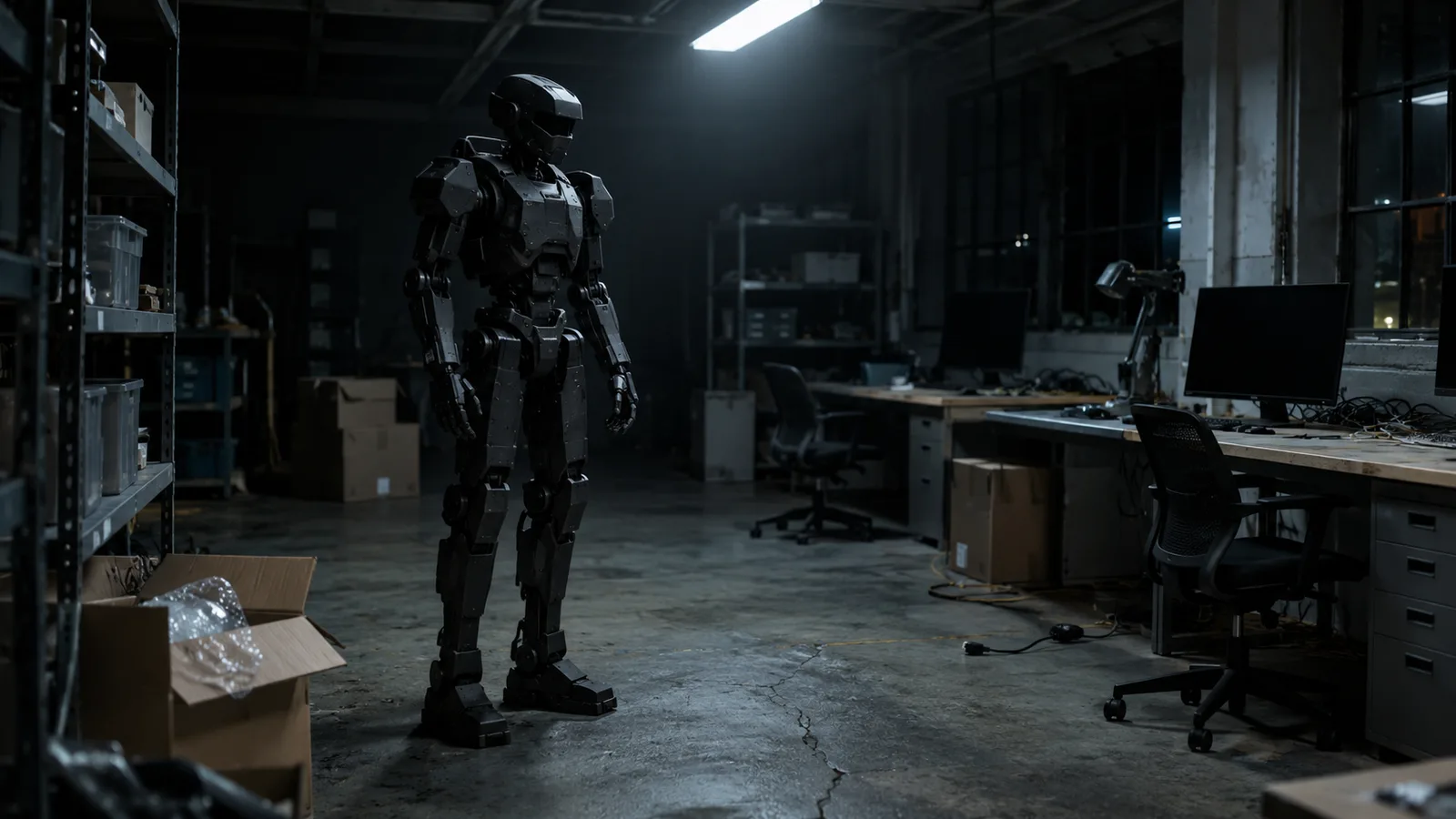
Foundation Future Industries, the San Francisco startup behind the Phantom military humanoid and backed by Eric Trump, has not paid its staff since October 30, 2026, CNBC reported on November 14. Its CEO, Sankaet Pathak, borrowed $4.6 million from the company in 2025, and an LLC he controls bought a $4.6 million home in October. This is not the end of humanoid robots. It is the start of a split between companies with real capital and factories, and companies with big valuations and little cash. Tesla Optimus sits firmly in the first group.
- The news: Foundation missed its October 30 payroll and was still unpaid when CNBC published (CNBC).
- The gap: it has sought about $500M at a $3B+ valuation, but has raised only about $21M in total (The Next Web).
- The wider trend: more than 20 Chinese robot companies have stopped operating or entered liquidation in 2026 (Humanoid.guide).
- Yet money still flows: humanoid startups raised $6B+ in 2025 and $4B+ so far in 2026, mostly into a few leaders (Humanoid Intel).
- For Optimus: each failure like this makes Tesla's self-funded, factory-first model look stronger to customers and investors.
What Happened at Foundation
According to CNBC's investigation, published November 14, Foundation missed payroll on October 30 and had still not paid employees two weeks later. It was not the first warning sign. In August, the company also ran short, and staff waited about two days for a bridge loan from an existing investor, as Startup Fortune summarizes.
The detail that made the story explode is the loan. Pathak took a $4.6 million company loan in 2025, described at the time as short-term. In October 2026, an LLC with Pathak as its only principal bought a $4.6 million home in Sausalito, California. Existing shareholders reportedly learned about the loan only from financial disclosures. Pathak told staff in a memo that he is working to secure the missed wages.
| Fact | Detail |
|---|---|
| Company | Foundation Future Industries (San Francisco), founded April 2024 |
| Product | Phantom MK-1 humanoid, MK-2 planned |
| Focus | Military and industrial humanoids |
| CEO | Sankaet Pathak, also the only board member and majority owner |
| Payroll | Missed Oct 30, 2026; short in August 2026 |
| CEO loan | $4.6M company loan in 2025 |
| Fundraising | Seeking ~$500M at $3B+ since at least January; ~$21M raised |
| Government work | ~$24M in Army, Navy and Air Force research contracts, via the Boardwalk Robotics acquisition |
| Notable backer | Eric Trump, investor and chief strategy adviser since April |
👉 Takeaway: The loan grabs headlines, but the core issue is simpler. A company valued at $3 billion on paper was living on bridge loans.
The Governance Red Flags Investors Missed
Foundation's structure made this kind of crisis easier. Pathak is the only board member and holds most of the equity. That means no independent director was in a position to approve or block a multi-million-dollar loan to the CEO.
There was also history. Pathak previously led Synapse, a banking-as-a-service company that collapsed in 2024. More than 100,000 Americans lost access to about $265 million in deposits, and a bankruptcy trustee found up to $96 million in customer funds unaccounted for. Pathak has not been named in the federal grand jury investigation into Synapse (Startup Fortune).
The government contracts were also smaller than they sounded. Media often cited "$24 million in Pentagon contracts." CNBC reports those belong to Boardwalk Robotics, a Florida company Foundation bought in late 2024, and payouts depend on milestones that have not been met. These are research agreements, not orders for robots.
💡 Insight: In a hot sector, a famous backer and a defense angle can stand in for due diligence. "We have to win robotics in the United States of America," Eric Trump said of the company. Patriotism is not a balance sheet.
The Math That Does Not Work
Foundation's own targets show how far its ambition ran ahead of its cash. In April, it described plans for 40 units in 2025, 10,000 in 2026 and 50,000 by the end of 2027, according to The Next Web. Each Phantom MK-1 cost about $150,000 to build, with leases around $100,000 a year.
Run the numbers:
- 10,000 robots at $150,000 each is $1.5 billion in build cost alone, before factories, software and payroll.
- Total money raised: about $21 million, or 1.4% of that figure.
- Valuation to capital raised: $3 billion ÷ $21 million ≈ 143x.
Scaling is the hardest part of humanoids, not the demo. An engineering director at Leju Robotics, which is building a 10,000-unit-a-year humanoid plant in Foshan, China, put it plainly to reporters:
"To produce one robot is not a challenge. How to produce 10,000 robots with the same standard, it's a challenge."
— Huhehanggai, Leju Robotics, via ClickOrlando
👉 Takeaway: A humanoid company needs factory-scale money. A startup that has raised tens of millions while promising tens of thousands of robots is selling a story, not a supply chain.
Foundation vs Tesla Optimus and the Funded Leaders
Here is how Foundation compares with the companies that do have the capital. Startup figures come from Humanoid Intel's funding tracker; Tesla figures from Musk's November interview, reported by Not a Tesla App, and Tesla's Q3 results (AP via News4JAX).
| Company | Capital behind it | Valuation | Build cost per robot | Production status |
|---|---|---|---|---|
| Tesla Optimus | Tesla's balance sheet; $20B 2026 capex plan; $1.5B Q3 free cash flow | Part of Tesla (~$1.5T) | ~$30K at first, toward $20K (Musk) | Early production on a Fremont line planned for 1M a year |
| Figure AI | $2.4B+ raised | $39B | Not disclosed | Pilot deployments |
| Apptronik | $935M+ raised | $5.5B | Not disclosed | Pilot deployments |
| Skild AI (robot brains) | $1.83B raised | ~$14B | Software, not hardware | n/a |
| Foundation | ~$21M raised | $3B+ sought | ~$150K | Small batches; two units tested in Ukraine |
For deeper comparisons, see our Tesla Optimus vs Figure AI vs Atlas breakdown and the Figure AI stock guide.
💡 Insight: Tesla's advantage is not only AI. It is the boring stuff: a factory, a supply chain, and cash flow from cars and energy. Tesla can afford to rent Optimus robots out, as Musk now plans, because it can carry the hardware on its own books for years. A startup with $21 million cannot.
Is the Humanoid Bubble Bursting? Not Yet. It Is Splitting
Foundation is not alone. The wider picture in 2026 looks like this:
- China: more than 20 robot companies have stopped operating or entered liquidation this year, per Sina. Shenzhen's Yinhe Robotics is in bankruptcy liquidation, and staff at Nanjing Wujing Future Power say their wages stopped in August (Humanoid.guide).
- Public markets: Agility Robotics began trading on Nasdaq as AGLT on November 5 after its SPAC merger, then fell sharply in its first week. We track it on our Agility Robotics stock page.
- Deal friction: China blocked the SoftBank–ABB Robotics deal on its soil, and the parties are weighing a carve-out.
At the same time, money is still pouring in at the top. Humanoid startups raised $6B+ in 2025 and $4B+ so far in 2026. Foundry Robotics closed a $100M Series A on October 30, and Bloomberg reported on November 12 that SoftBank is backing Agile Robots in a $500 million humanoid push.
So the right word is not "bust." It is concentration. Capital is flowing to a handful of leaders with real products, real customers and real factories. Weaker companies with paper valuations are running out of runway.
👉 Takeaway: This looks like the electric-vehicle shakeout of 2021–2023. Dozens of startups, a few survivors, and the incumbent with factories (then Tesla, now Tesla again) gained the most.
Who Wins and Who Loses
| Player | Impact | Why |
|---|---|---|
| Tesla / TSLA (Optimus) | ✅ Wins | Self-funded, factory-scale; customers prefer a supplier that will exist in five years |
| Figure, Apptronik, Agility | ✅ Mostly win | Less competition for talent and pilots, but investors will ask harder questions |
| Chinese leaders (Unitree, UBTech, AgiBot) | ✅ Win | Cost leadership plus consolidation at home |
| Component suppliers | ⚠️ Mixed | Fewer small customers, more volume with big ones; see our humanoid robot stocks list |
| Small humanoid startups | ❌ Lose | Harder fundraising, more due diligence on governance |
| Military humanoid niche | ❌ Loses credibility | The best-known "robot soldier" company could not pay staff; more in our humanoid robots in war analysis |
| Foundation employees | ❌ Lose | Unpaid wages and an uncertain future |
What Happens to Foundation Next: Three Scenarios
These are our editorial estimates.
- Rescue round (25%). An investor steps in with new money, likely with tough terms such as a new board and limits on the CEO. Staff get paid, but the $3B valuation is gone.
- Sale for parts (40%). A larger defense or robotics company buys Foundation for its team, Boardwalk's government contracts and its IP. This is the most common outcome for startups in this position.
- Shutdown (35%). No buyer appears before legal and payroll pressure peaks. Remaining assets go to creditors.
Checklist: How to Spot a Zombie Humanoid Startup
Before you invest, take a job or sign a pilot with a humanoid company, check these six points:
- Board: Is there at least one independent director? A one-person board is a red flag.
- Raised vs valuation: If the valuation is over 50x the money actually raised, ask why.
- Contracts: Are "government contracts" research grants with milestones or real purchase orders?
- Unit cost: What does one robot cost to build, and what is the plan to cut it?
- Production proof: Can they show a line, not just a lab, and a delivery count?
- Founder history: Look up prior companies and any open investigations.
✔ For investors: public humanoid exposure with real balance sheets is available through Tesla, component makers and ETFs. Start with our Optimus stocks hub and the humanoid robot ETF guide.
FAQ
What is Foundation Future Industries?
It is a San Francisco startup founded in 2024 that builds the Phantom humanoid robot for military and industrial work. Eric Trump is an investor and chief strategy adviser.
Why did Foundation miss payroll?
It ran out of cash while trying to raise about $500 million at a $3 billion+ valuation. It has raised only around $21 million so far, and a CEO loan of $4.6 million has added to the scrutiny.
Is the humanoid robot industry in a bubble?
Parts of it are. Many small companies are failing, especially in China, but leaders such as Figure and Tesla still attract billions. The industry is consolidating rather than collapsing.
Does this affect Tesla Optimus?
Not directly. If anything, it helps Tesla, because buyers and investors now care more about who has the money and factories to deliver at scale.
Can I invest in Foundation?
No. It is a private company. Public ways to get humanoid exposure include Tesla, robot component suppliers and humanoid robot ETFs.
Summary
Foundation's missed payroll is a warning about one company's governance and a signal for the whole sector. Building humanoid robots at scale takes billions in capital, factories and patience. Companies with paper valuations and thin cash are starting to break, while capital concentrates in a small group of leaders. Tesla, with its own factories and cash flow, is one of the clearest beneficiaries of that shakeout.
Want to see which public companies sit behind the humanoid boom? Explore our Optimus stocks hub.
TRACKING THE HUMANOID RACE
We follow every serious humanoid maker and supplier, and how each one compares with Tesla Optimus.
