
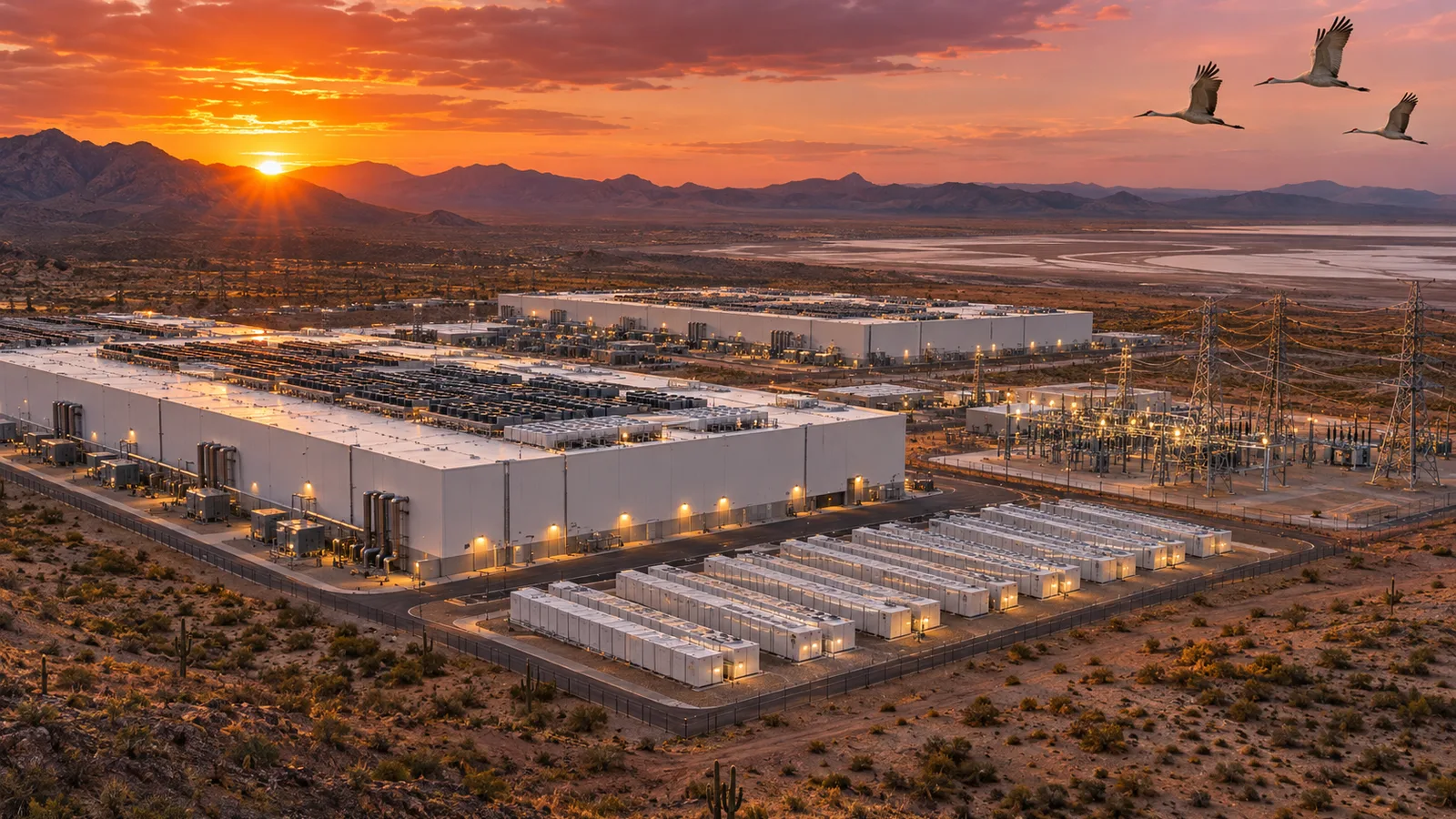
On November 12, 2026 SpaceX confirmed more than $74 billion of new AI supercomputing campuses: about $50 billion in Cochise County, Arizona (up to 6 GW) and $24 billion at Starbase, Texas, with its own gas power plant. Both face public votes on December 9. Our read: $74B is only the shell and the power. At Nvidia's own benchmark, filling 6 GW with chips would cost $300 billion or more.
- Arizona: 747-acre site near Willcox Playa, 4 phases × ~1.5 GW, 24 GWh battery, dry cooling (Teslarati).
- Texas: ~444 acres at Starbase, 35 mobile gas turbines (~750 MW) off the state grid (Teslarati).
- Jobs: ~5,500 construction + 1,000 permanent in Arizona; 3,000+ construction + 500 permanent in Texas.
- Why: SpaceX had 1.7 GW of compute at end-Q3 2026 and wants at least 10 GW more in 2027.
- Next dates: Arizona comments due Nov 27; both hearings Dec 9; construction could start March 2027.
What SpaceX Announced
SpaceX, which absorbed xAI in 2026 and now runs its AI arm as SpaceXSI, said the sites will train models for medicine, emergency response, manufacturing and national security, and test space-based computing (Stocktwits). The Arizona application was filed under a different name, Tombstone Resources LLC. A SpaceX representative said putting SpaceX on it "draws attention" from outside the county.
| Cochise County, Arizona | Starbase, Texas | |
|---|---|---|
| Investment | ~$50B | ~$24B (initial phases) |
| Land | 747 acres (+348 acres being bought) | ~444 acres |
| Power | Up to 6 GW in 4 phases; 24 GWh battery; $3.6B grid upgrades | 35 mobile gas turbines, ~750 MW (per Politico) |
| Grid | Next to Apache Generating Station (~1 GW, due to retire by 2028) | Off-grid, own plant |
| Water | Dry cooling, 7–10 acre-feet/year | Not disclosed; $220M pledged to Brownsville water systems |
| Jobs | ~5,500 construction / 1,000 permanent | 3,000+ construction / 500+ permanent |
| Key vote | Planning & Zoning hearing, Dec 9, Bisbee | City Commission tax abatement, Dec 9, 7 p.m. |
👉 Takeaway: Arizona is the scale play, Texas is the speed play. Texas uses its own gas turbines to skip a frozen state grid queue.
The Math Nobody Is Doing: Cost per Gigawatt
Jensen Huang told G20 ministers that AI infrastructure costs about $50–60 billion per gigawatt, chips included (Crypto Briefing). Apply that to SpaceX's numbers:
| Site | Announced | Power | Announced $ per GW | All-in at $50–60B/GW |
|---|---|---|---|---|
| Arizona | $50B | 6 GW | ~$8.3B | $300–360B |
| Starbase | $24B | ~0.75 GW | ~$32B | $37–45B |
| Total | $74B | ~6.75 GW | ~$11B | $340–405B |
Two conclusions:
- Arizona's $50B is buildings, power and storage, not GPUs. At ~$8B per GW there is no room for Nvidia or Terafab chips. The full bill is several times higher and will be spent over years.
- Starbase is denser. ~$32B per GW suggests that site's figure includes much more of the compute itself, or the turbines are only the first block of a bigger build.
Where does that money come from? SpaceX already leases part of its Colossus capacity to Anthropic for about $1.25 billion a month through May 2029, and Google is also a customer. Compute is now a revenue line, not just a cost for Grok.
💡 Insight: The $74B headline understates the real capex by roughly 4–5x. That is the number to watch for SPCX valuation, Terafab demand and any SpaceX–Tesla deal (see our SpaceX–Tesla merger analysis).
Why SpaceX Needs So Much Power
SpaceX ended Q3 2026 with 1.7 GW of nameplate compute, mostly near Memphis. It targets 2.5–3 GW by year-end and wants at least 10 GW more in 2027. The full Arizona build alone would be more than three times today's fleet, and would draw about 2.5x the power of every data center in Maricopa County combined, per an Arizona Republic analysis cited by Teslarati.
The power problem is also political. Texas Gov. Greg Abbott paused new data center grid connections in August, and Governor-elect Gina Hinojosa has said she will block data center approvals from January until the legislature passes protections. That explains Starbase's own gas plant. Musk's comment after the election: "Data centers in space looking pretty appealing right now."
That line connects to Starmind, SpaceX's plan for up to 1 million orbital data-center satellites, first launches planned for 2027. Ground campuses are the bridge until space compute works. We compared the two in Starmind vs data centers and why Musk wants compute off Earth.
✔ Takeaway: Power, not chips, is SpaceX's bottleneck in 2027. Whoever controls megawatts controls the AI race.
Who Wins
- SpaceX / SpaceXSI: more training capacity for Grok and more capacity to rent, at a time when compute is sold out.
- Chip suppliers: Nvidia today; Terafab tomorrow if Musk's own fab delivers. 6 GW is one of the biggest single chip orders on the planet.
- Battery storage: a 24 GWh system is huge. Tesla has not been named as supplier, but if it were Megapack, at an assumed $200–250/kWh that is a $5–6 billion order. See Tesla Energy stock.
- Gas turbines and grid builders: 35 mobile turbines in Texas and a $3.6B grid upgrade in Arizona; the Apache station could expand from ~1 GW to more than 6 GW, per SpaceX.
- Cochise County: a new tax base, 1,000 permanent jobs and a SpaceX claim that local co-op members could see bills cut by up to 20%.
- Optimus: indirectly. Grok runs inside Tesla Optimus, and more compute means faster model training (Optimus + Grok).
Who Loses or Takes the Risk
- Local residents: about 2,400 people signed a petition to deny the Arizona permit. The playa is a landing area for federally protected sandhill cranes.
- Air quality in the Rio Grande Valley: the South Texas Environmental Justice Network plans a protest over emissions, water and bills. SpaceX's Memphis turbines already face a residents' lawsuit, and Mississippi regulators found SpaceXAI started construction there without permits (KJZZ).
- Governance critics: two of the three Starbase commissioners voting on the tax break are SpaceX executives, according to Politico.
- Other data center developers: competing for the same turbines, transformers and grid slots.
| Stakeholder | Effect | Confidence |
|---|---|---|
| SPCX shareholders | ➕ more capacity, more lease revenue; ➖ $300B+ capex | Medium |
| Nvidia / Terafab | ➕ multi-GW chip demand | High |
| Tesla Energy | ➕ if it wins the 24 GWh storage order | Low (not confirmed) |
| Cochise County | ➕ taxes, jobs / ➖ land, wildlife | High |
| Texas residents near Starbase | ➖ air permits, tax break | Medium |
Three Scenarios
- Fast track (35%): both Dec 9 votes pass, Arizona breaks ground in March 2027, SpaceX hits 5+ GW by end-2027.
- Delayed (45%): Arizona passes with conditions (cranes, noise, water), Texas stalls on TCEQ air permits and the new governor's freeze. Growth shifts to Memphis, Arizona and Starmind.
- Blocked (20%): Cochise County denies the permit or lawsuits stop it. SpaceX looks for another state and leans harder on space-based compute.
Probabilities are our editorial estimate, not financial advice.
What to Watch (Checklist)
- Nov 27: end of written comments in Cochise County.
- Dec 9: Planning & Zoning hearing (Bisbee) and Starbase tax abatement vote.
- TCEQ ruling on the 35-turbine air permit.
- Any named chip or storage supplier (Nvidia, Terafab, Tesla Megapack).
- SpaceX's end-2026 compute number vs the 2.5–3 GW target.
- Starmind's first launch date in 2027.
FAQ
How much is SpaceX investing in AI supercomputers?
More than $74 billion: about $50 billion in Cochise County, Arizona and $24 billion at Starbase, Texas, announced November 12, 2026.
Where is SpaceX's Arizona data center?
On a 747-acre site near the Willcox Playa in Cochise County, about 80 miles east of Tucson, filed under Tombstone Resources LLC.
How much power will it use?
Up to 6 GW at full build in four ~1.5 GW phases, backed by a 24 GWh battery system. The Starbase plant is about 750 MW.
When will construction start?
If the December 9 hearing goes SpaceX's way, construction in Arizona could start in March 2027.
Is this connected to Starmind?
Yes, indirectly. SpaceX says the sites will also test space-based computing, and Musk sees orbital data centers as the long-term answer to power limits on Earth.
Summary
SpaceX's $74 billion is the down payment, not the bill. At Nvidia's benchmark the full 6.75 GW build would be worth $340–405 billion with chips, which makes SpaceX one of the largest AI infrastructure buyers in the world. December 9 decides how fast it happens. Follow our SpaceX stock, xAI stock and Optimus stocks hub pages; we will update this article after the votes.
TRACKING THE MUSK ECOSYSTEM
We follow how SpaceX, SpaceXSI, Terafab, Tesla and Optimus connect, from compute and chips to the stocks they move.
