
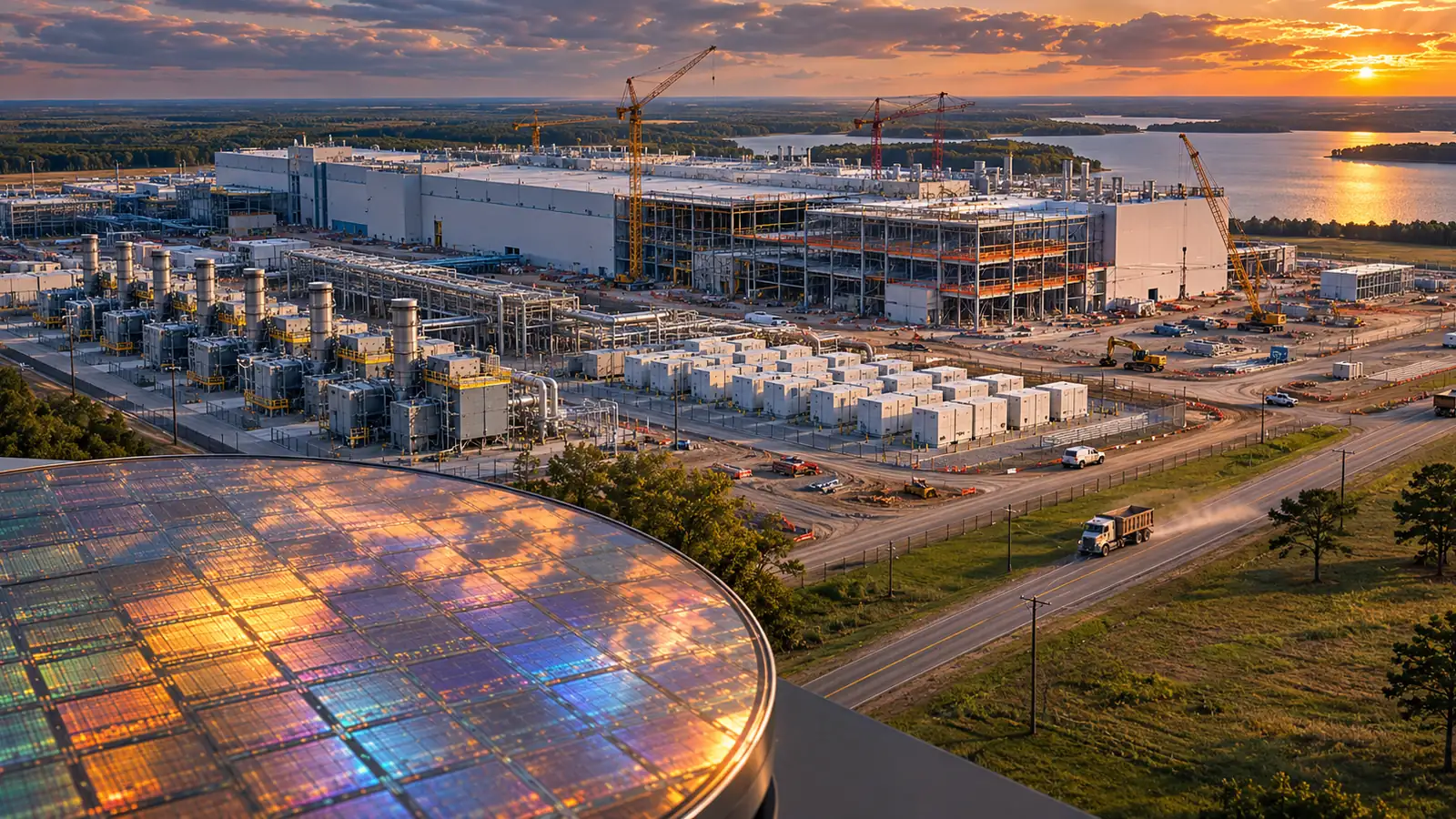
Terafab's price tag was never announced at a press conference. It surfaced in Texas tax paperwork, and SpaceX is now in court trying to keep the rest of that paperwork sealed. What the public record already shows is more interesting than the headline number: a four-phase, ten-year option on a chip complex, of which only the first $16.8 billion is real money today.
👉 Bottom line: Terafab could cost up to $119.4 billion across four phases from 2026 to 2036, according to Texas JETI applications reported by ENR. Only Phase 1 (about $16.8B) is committed, and every later phase is a separate go/no-go decision.
- The number: $16.8B (Phase 1, 2026–28) + $38.6B (Phase 2) + $38.6B (Phase 3) + $25.3B (Phase 4) ≈ $119B.
- The fight: SpaceX sued Texas AG Ken Paxton and Grimes County in September 2026 to block release of costs, land, design and incentive records; a citizens' group countersued on October 27.
- The timeline: Musk calls Q3 2028 volume production an "aspiration." Industry build times point to 2030 as the realistic date for meaningful output.
- Biggest winners: ASML and US tool makers, gas-turbine suppliers, Texas trades, and TSMC, which gains leverage whichever way talks go.
- Most exposed: Intel (if TSMC takes the operator role), Nvidia's margins in the long run, and Grimes County residents, who carry the roads and the uncertainty.
Where the $119 Billion Figure Comes From
The $119B figure is not a SpaceX budget. It is the sum of investment ranges in eight applications filed under Texas's Jobs, Energy, Technology and Innovation Act (JETI), which split the build into four phases at and around Gibbons Creek Reservoir in Grimes County, about 20 miles east of College Station.
According to ENR's review of the filings, the county notice put the "initial phases" at about $55 billion, rising to $119 billion if every phase is built. The reinvestment zone covers more than 22,000 acres, though that does not mean all of it will be developed.
The four phases, by the numbers
| Phase | Construction window | Eligible investment | Cumulative | What it implies |
|---|---|---|---|---|
| Phase 1 | 2026–2028 | ≈ $16.8B ($10.37B Anderson-Shiro + $6.43B Iola) | $16.8B | One leading-edge fab plus utilities, power plant and a research line |
| Phase 2 | 2029–2031 | ≈ $38.6B | $55.4B | Matches the "$55B initial phases" in the county notice |
| Phase 3 | 2032–2034 | ≈ $38.6B | $94.0B | A true multi-fab campus, roughly TSMC-Arizona scale |
| Phase 4 | 2035–2036 | ≈ $25.3B | ≈ $119.4B | Final build-out; only if earlier phases hit their targets |
Sources: JETI applications as summarized by ENR; "implies" column is Optimusk analysis.
One detail clears up a confusion you will see repeated online. Some analysts flagged the August 6 figure of $16.8B as 62% above the $10.37B in the applications. But ENR's breakdown shows Phase 1 spans two school districts, and the two applications ($10.37B + $6.43B) add up to exactly $16.8B. The announced number and the filings agree.
💡 Insight: each JETI phase is described as "independently capable of manufacturing semiconductors." In plain English, SpaceX has structured Terafab as four separate bets, not one $119B commitment. That is what makes the headline number both true and misleading.
What the Records Fight Is Really About
The paper trail started small. Two Grimes County residents requested the Terafab and tax-abatement records. The county asked the Attorney General what it could withhold, and on July 28, 2026 Paxton's office ruled that only certain attorney-client communications could stay private. The rest had to be released.
SpaceX then sued Paxton and the county in September to keep costs, land-acquisition records, structural-design details and incentive negotiations under seal, arguing trade secrets and "substantial competitive harm," as reported by the Austin American-Statesman and KBTX.
On October 27, the Grimes County Citizens for Responsible Development filed its own suit in Travis County to force release and to intervene against SpaceX, per KLTV. Their attorney, Bill Aleshire, argues that once a deal is signed, the information becomes public unless a law makes it confidential. He expects a hearing as early as December, with orders possibly by spring 2027.
“Since the first commissioners court meeting on April 1, residents have faced nothing but a brick wall.”
— Marie Egyed, GCCRD, via KLTV
Why SpaceX cares so much about a county records request
- Cost data reveals bargaining power. The filings already say that without the tax limitation, Terafab's internal rate of return falls below the minimum, and the project "would likely be relocated outside Texas," possibly to Arizona (Fortune). Detailed costs would show how much of that threat was real.
- Design details reveal the process choice. Cleanroom specs hint at which node and which partner. That is exactly what SpaceX, Intel and TSMC are still negotiating.
- The commitment is softer than the headlines. The county agreement requires only $5B invested by the end of 2030 and 1,800 jobs by the end of 2035, and SpaceX can terminate on 30 days' notice, per Cape Fear Advisors' read of the agreement. More disclosure invites more scrutiny of that gap.
👉 Takeaway: the lawsuit is less about hiding a price and more about protecting negotiating leverage while the operator question (Musk vs. TSMC vs. Intel) is still open.
The Real Commitment: An Option, Not a Megaproject
Strip away the headlines and here is what is legally locked in today:
- $10 million paid upfront to Grimes County (paid early, before the August 2 deadline).
- $20 million a year in payments from 2027 through 2036, in lieu of taxes on a 100% abatement.
- A $30 million Texas Enterprise Fund grant from the state.
- Land cleared by late September 2026, and a Tesla-run construction-management team hiring in Anderson, Texas.
SpaceX's own prospectus describes Terafab's projects, timelines, milestones and capex as "not yet determined." Meanwhile the company guided $35–40 billion of capex for Q4 2026 alone, CFO Bret Johnsen said on the Q3 2026 earnings call.
💡 Our math: even the full $119B, spread over 2026–2036, averages about $12B a year. That is less than one-third of what SpaceX plans to spend in a single quarter right now, mostly on Nvidia compute. Terafab is a hedge sized against the AI-chip bill, not a bet-the-company project.
Why a hedge makes sense: the Nvidia margin math
Johnsen has called SpaceX "NVIDIA exclusive" and said chip allocation is "the piece that we don't control." Nvidia posted a 75.0% GAAP gross margin for the quarter ended July 26, 2026. When three-quarters of every GPU dollar is someone else's margin, a fab that captures even part of that spread pays for itself, as long as it works.
✔ Mini takeaway: Terafab's economics depend less on the $119B and more on how much of the Nvidia and foundry margin SpaceX can pull in-house by 2030.
The Realistic Timeline: 2028 Is the Pilot, 2030 Is the Fab
On the Q3 call, Musk set two dates and hedged both with "big error bars":
- A first functional test chip (probably SRAM) around May–June 2027 at the research fab in Austin.
- Volume production around Q3 2028 at Gibbons Creek, which he called an "aspiration" and "very aggressive."
Now compare that with what the industry actually does. Texas filings list Terafab construction starting December 1, 2026. Exyte's Herbert Blaschitz estimates a large US fab takes about 38 months from permits to production, versus about 19 months in Taiwan (TrendForce). TSMC CEO C.C. Wei says a new fab takes 2–3 years to build and 1–2 years to ramp.
| Benchmark | Start | Implied volume production |
|---|---|---|
| Musk's "aspiration" | Dec 2026 | Q3–Q4 2028 (≈ 21–24 months) |
| Taiwan-speed build (19 mo + ramp) | Dec 2026 | Mid-2028 pilot, 2029 volume |
| US average (Exyte, 38 mo) | Dec 2026 | Early 2030 |
| TSMC rule of thumb (2–3 yr + 1–2 yr ramp) | Dec 2026 | 2030–2031 |
Other signals line up with the slower path. Terafab is reportedly set to receive its first ASML EUV tool in mid-2027, before the building shell is finished (Let's Data Science, citing Tom's Hardware). And the taxable-value schedule in the JETI filings shows only about $4.2B of property on the ground for 2028, rising to $10.7B in 2029. That is a site still filling with tools, not one shipping wafers at scale.
👉 Our forecast: a working pilot line at Gibbons Creek in late 2028 is plausible. Meaningful volume, the kind that moves Optimus or orbital-compute supply, is a 2030 story. For the full construction calendar, see our Terafab size and completion date guide.
Who Wins From Terafab's $119B Buildout
Fabs are capital-heavy and job-light. Building the shell is typically only $4–6 billion of a $20B+ leading-edge fab, per TrendForce. The rest goes to tools, utilities and cleanroom systems. Apply that ratio and roughly $80–95 billion of a full Terafab would flow to equipment and process suppliers. That tells you where the money really lands.
1. ASML and the US tool makers
ASML is the clearest winner because it is the only source of EUV scanners. Its CFO Roger Dassen confirmed in July that 2027–2028 capacity plans already include the project.
“We're in dialogue with all our customers and we know ... what their building plans are. Terafab is also part of those plans.”
— Roger Dassen, ASML CFO, via Reuters/Euronext
Behind ASML stand deposition, etch and inspection vendors such as Applied Materials, Lam Research and KLA, plus Tokyo Electron. Their payoff does not depend on who operates the fab, Musk or TSMC. Tools get bought either way. More on the equipment chokepoint in Terafab Chips: ASML, TSMC and What It Will Make.
2. TSMC, which wins either way
In October Musk wrote, "No, we will build and run the fab," and offered TSMC at most a sublease (Tom's Hardware). Eight days later Wei answered on TSMC's earnings call:
“We are still in discussion. But the fab got to be run by TSMC.”
— C.C. Wei, TSMC CEO, via The Next Web
By November 1, Digitimes reported that Musk had "softened his stance" and that talks could move toward TSMC taking primary responsibility for construction and operations (Bits and Chips, Digitimes). If TSMC runs it, TSMC gets a customer-funded Texas fab. If talks fail, Musk's companies remain major TSMC customers anyway. TSMC's US build-out is already $165 billion in Arizona, so it does not need Terafab. Terafab needs TSMC's experience more.
3. Gas turbines, batteries and Texas power
Terafab is designed to run on onsite gas turbines and utility-scale batteries, not the grid. That puts it in line for the same turbine slots as every AI data center. GE Vernova's gas backlog plus reservations hit 116 GW in mid-2026, with output of only 24 GW planned for 2028 (Turbomachinery). Power equipment is a quiet Terafab bottleneck, and a quiet winner.
4. Texas trades and Grimes County's budget
Phase 1 alone promises 3,000 jobs, according to Governor Abbott. Before a single wafer, Tesla is hiring construction project managers, superintendents and logistics staff in Anderson. For the county, $10M upfront plus $20M a year totals about $210 million over ten years. With roughly 30,000 residents, that is around $7,000 per person.
✔ Winners' checklist: tool makers (paid first), TSMC (leverage), power-equipment vendors (scarce slots), Texas construction (now), Grimes County budget (guaranteed payments until SpaceX exits).
Who Loses or Takes the Risk
1. Intel: from headline partner to open question
Intel joined in April, and Musk said Terafab would use Intel's 14A process. Intel's own 10-K warned it might pause 14A without a major external customer, so Terafab was its validation. Lip-Bu Tan said in October that Intel is staying in. But the Digitimes report did not say what Intel's role would be if TSMC takes over. And SpaceX's filings note that partners are not obliged to stay and that definitive agreements may never be signed (Yahoo Finance). Our full breakdown is in Intel and Terafab: The Partnership Explained.
💡 Insight: a 14A-tuned fab cannot simply switch to TSMC's A14 or A16 processes. If TSMC operates, Intel is likely reduced to a licensor at best, which would remove 14A's flagship outside customer.
A possible SpaceX–Tesla combination would reshuffle this further; we cover that in SpaceX Tesla merger: who wins, who loses.
2. Nvidia, in the long run
Not soon. SpaceX's 2027 build-out is "primarily Rubin, Vera Rubin compute," Musk said on the Q3 call, with a cluster of about 440,000 Vera Rubin systems targeted by end of Q2 2027. But every in-house AI5 or AI6 chip that eventually ships from Texas is a chip SpaceX does not buy at a 75% gross margin. Terafab is a 2030s risk to one of Nvidia's largest customer relationships, not a 2027 one. See our Nvidia robotics stock page for how that fits Nvidia's robotics bet.
3. Samsung's Texas foundry
Samsung confirmed it will make Tesla's AI5 in Texas, with high-volume production in the second half of 2027 (Not a Tesla App). That contract is safe for years. But Terafab exists precisely to cut reliance on outside foundries, so a successful Terafab caps Samsung's share of Musk's chips in the AI6 era and beyond.
4. Other Texas fabs competing for the same people
The SIA projects a US shortfall of about 67,000 chip workers by 2030, including roughly 26,400 technicians and 27,300 engineers (SIA). Terafab will recruit from the same pool as Samsung Taylor, Texas Instruments and TSMC Arizona. Expect wage pressure for fab technicians across the Texas Triangle. Practical advice for job seekers is in our Terafab jobs guide.
5. Grimes County residents
Six county roads are designated for construction traffic, the reservoir supplies process water, and residents still cannot see the deal terms. If SpaceX exits before June 1, 2027, it does not owe the 2027 payment. The upside is real, but so is the risk of hosting the world's largest building on a 30-day termination clause.
Quick Comparison: Winners vs. Losers
| Player | Verdict | Why | When it shows up |
|---|---|---|---|
| ASML, AMAT, Lam, KLA, TEL | Winner | ~70–80% of fab spend goes to tools and systems | 2027–2029 orders |
| TSMC | Winner | Leverage in talks; wins as operator or as supplier | Talks now; deal 2027? |
| Power equipment (turbines, batteries) | Winner | Onsite power for the full campus | 2027–2028 |
| Texas construction trades | Winner | Phase 1 build, 2026–2028 | Now |
| Intel | At risk | 14A role unclear if TSMC operates | Next 6 months |
| Nvidia | Long-term risk | In-house chips replace 75%-margin GPUs | 2030+ |
| Samsung Foundry | Mixed | AI5 safe; AI6+ share at risk | 2028+ |
| Grimes County | Mixed | $210M in payments vs. roads, water, opacity | Ongoing |
What Terafab Means for Tesla Optimus and AI5
Here is the part most coverage gets wrong: Terafab does not gate Optimus in 2027. Tesla's AI5 comes from Samsung's Texas fab and TSMC, with Musk saying high-volume production is "only possible in 2027." Optimus V3 production depends on those outside foundries.
Terafab matters later. Musk's vision includes up to 1 million Optimus robots, and SpaceX's orbital-compute targets run into the tens of gigawatts, and they depend on Starship actually flying (see our Starship Flight 15 recap). At that scale, competing with Apple, Nvidia and AMD for booked-out leading-edge foundry capacity stops working. Terafab is the bet for the 2029–2032 scale-up, not the 2027 launch. Our announcement breakdown explains why roughly 80% of Terafab's output was pitched for space and data centers, not Tesla.
👉 For Optimus watchers: track Samsung Taylor's AI5 ramp in H2 2027 for the near term, and the Terafab test chip in mid-2027 for the long term. For stock angles, see our Tesla Optimus stock catalysts and the Optimus stocks hub.
Three Scenarios for Terafab Through 2030
These are Optimusk's editorial probabilities, based on the public record as of November 13, 2026.
| Scenario | Probability | What happens | Likely spend by 2030 |
|---|---|---|---|
| Bull: Musk builds and runs it | 20% | Intel 14A license works, pilot line late 2028, Phase 2 approved in 2029 | $30–55B |
| Base: TSMC-run or joint venture | 55% | TSMC operates all or part of Phase 1; volume around 2030; Phase 2 delayed | $17–30B |
| Bear: research fab plus the minimum | 25% | Phase 1 slowed or cut; SpaceX keeps buying from TSMC and Samsung; meets the $5B county floor | $5–10B |
Why the base case wins: Musk has already moved from "ZERO doubt" in early October to reopened TSMC talks a month later. He also admitted on the Q3 call, "we're just figuring out chip fabrication." Building a leading-edge fab from scratch, with a first-time operator, at Taiwan speed, in Texas, is something no company has done.
Checklist: 7 Signals That Will Tell You Which Scenario Is Coming
- A signed TSMC agreement, or an 8-K or 10-Q naming a binding Terafab partner.
- Intel's next update on 14A customers. Silence on Terafab would be telling.
- The records hearing in Travis County, expected around December 2026, and any court-ordered release.
- EUV delivery in mid-2027 and whether the building shell is ready to receive it.
- The SRAM test chip at the Austin research fab, targeted for May–June 2027.
- June 1, 2027, the last day SpaceX can exit the county deal without the 2027 payment.
- County assignment. Any transfer of the abatement to a non-SpaceX entity, such as a TSMC-led JV, must go on a public commissioners' agenda.
For a running log of each milestone, bookmark our Terafab news tracker.
FAQ
How much will Terafab cost?
Up to about $119.4 billion across four phases from 2026 to 2036, per Texas JETI filings. Only Phase 1, about $16.8 billion, has been announced as committed.
Why is SpaceX suing over Terafab records?
To block release of cost, land, design and tax-incentive negotiation records that the Texas AG ordered public in July 2026. SpaceX says they are trade secrets. A citizens' group is suing for release.
When will Terafab start producing chips?
Musk targets a test chip in mid-2027 and volume in Q3–Q4 2028, which he calls an aspiration. Industry build times suggest volume production around 2030.
Will TSMC run Terafab?
Not decided. Musk ruled it out in October, TSMC said it must run any fab it joins, and Digitimes reported in November that talks have reopened.
Can I invest in Terafab directly?
No. Terafab has no ticker. Exposure comes through SPCX, TSLA, INTC and equipment makers. See our Terafab stock guide.
Summary
The $119 billion is a ceiling, not a check. What SpaceX has committed is a $16.8B first phase, $20M a year in county payments, and a 30-day exit clause. The records fight is about protecting leverage while Musk, TSMC and Intel settle who actually runs the fab. Tool makers, TSMC and Texas power suppliers win almost regardless of the outcome. Intel and, eventually, Nvidia carry the most risk. For Optimus, Terafab is a 2030s scale-up story.
Want the bigger picture? Start with What Is Terafab, then follow the money in our Optimus stocks hub.
FOLLOWING THE TERAFAB MONEY
We track every Terafab filing, court date and partner deal, and what it means for SpaceX, Tesla Optimus and the chip supply chain.
