
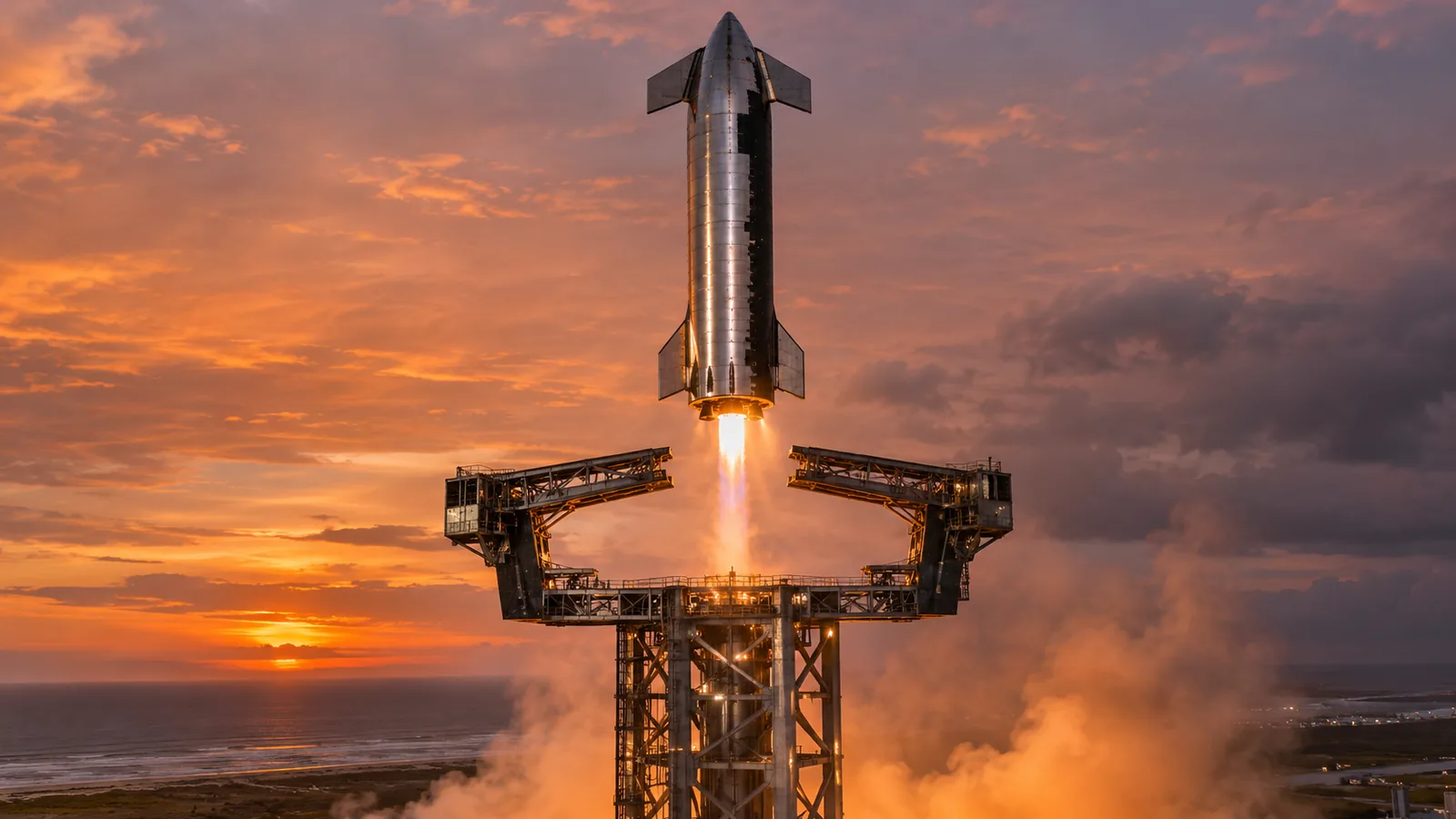
Starship Flight 15 launched from Starbase, Texas, on Friday, November 13, 2026, aiming for the first full recovery of an orbital rocket. Half of that plan is already gone: Super Heavy Booster 22 hit an automatic abort and splashed down in the Gulf of Mexico instead of returning to the tower. Ship 42 kept going, reached orbit with 26 Starlink V3 satellites, and is set to try the first-ever ship catch on Saturday.
That split result is more useful than a clean win or a clean failure. It shows exactly where SpaceX's risk sits in late 2026, and why one tower catch now moves a $1.9 trillion stock, a possible Tesla merger, NASA's Moon plan and Musk's Optimus-on-Mars story at the same time.
👉 Bottom line: Flight 15 is a partial success so far. The booster missed its catch, the ship made orbit, and Saturday's ship catch is the real test of whether Starship can become a fully reusable, airline-style rocket.
- What happened: Booster 22 aborted its return and splashed into the Gulf; Ship 42 reached orbit on a ~22.5-hour mission with 26 Starlink V3 satellites (AP).
- What's next: Ship 42 is scheduled to return to Starbase Pad 2 on November 14 at about 3:17 p.m. CST for the first ship catch in history (Spaceflight Now).
- Why it matters: no Starship upper stage has ever been recovered. All 14 earlier ships ended in the ocean, by design or by accident.
- Money angle: SpaceX (Nasdaq: SPCX) is worth about $1.9 trillion and Tesla about $1.57 trillion while merger talks progress (24/7 Wall St.). A ship catch strengthens SpaceX's side of that deal.
- Moon and Mars: propellant transfer is planned for early 2027 and the 2028 Moon landing needs it. A Starship flight to Mars with Optimus robots in 2026 is not happening; SpaceX's official target is no earlier than 2028.
Live Status: Starship Flight 15 at a Glance
| Item | Status |
|---|---|
| Vehicle | Super Heavy Booster 22 + Ship 42, both Block 3 (V3) |
| Launch site | Orbital Launch Pad 2, Starbase, Texas: first launch and catch attempt from this pad |
| FAA license | Revised license VOL 23-129 Rev. 10.0, issued hours before launch; one flight only; $500M liability insurance |
| Launch | Friday, Nov 13; window opened 4:45 p.m. CST (22:45 UTC) |
| Booster 22 | ❌ Automatic abort; splashdown in the Gulf of Mexico instead of a tower catch |
| Ship 42 | ✅ Reached orbit; ~14–15 orbits at ~275 km (171 mi) |
| Payload | 26 Starlink V3 satellites, deployed via the "Pez" dispenser |
| Ship catch | ⏳ Saturday, Nov 14, ~3:17 p.m. CST (21:17 UTC), only if every system is healthy; otherwise Pacific splashdown |
Sources: Spaceflight Now, AP, Seeking Alpha on the FAA license, Space.com live updates.
What Happened on Starship Flight 15
The FAA revised SpaceX's Starship license on launch day, authorizing a single Flight 15 launch plus reentry. Approval landed only hours before the window opened, on a day when a nationwide FAA ground stop over air traffic control problems was also in effect.
The plan was the most ambitious in Starship's history. Here is the published mission profile and what we know of the outcome:
- T+0:58 — Max Q. Peak aerodynamic pressure on the 407-foot stack.
- T+2:19 to 2:21 — Booster cutoff and hot staging. Ship 42 lights its engines while still attached.
- T+2:26 to 3:02 — Boostback burn. Booster 22 turns back toward Starbase.
- T+6:35 — Planned booster catch. Instead, the booster malfunctioned and hit an automatic abort, diverting to its pre-cleared Gulf of Mexico landing zone.
- T+8:09 — Ship engine cutoff, then an orbital insertion burn at about T+26 minutes.
- T+35 min to 1:17 — Starlink deployment window for 26 V3 satellites.
- ~21.5 hours later — Deorbit burn, timed so the ground track lines up with Starbase.
- T+22:32 — Planned ship landing burn and tower catch on Saturday, November 14.
Timeline from the Flight 15 mission profile and Tech Insider. SpaceX has not yet said why Booster 22 aborted.
"A breakthrough moment in making Starship a reliable, rapidly reusable rocket."
— SpaceX on the double catch goal, via Spaceflight Now
✔ Takeaway: the booster miss is a setback, not a crisis. Booster catches were already proven three times in 2024–2025. The unproven, high-value event is still ahead.
Why the Ship Catch Matters More Than the Booster Catch
Super Heavy boosters were caught on Flight 5 (Oct 2024), Flight 7 (Jan 2025) and Flight 8 (Mar 2025). Flight 15 would have been the first V3 booster catch and the first from Pad 2, but the core trick is known.
The upper stage is a different problem. It comes back from orbit at roughly 7.8 km/s, survives reentry on a heat shield, flips, relights its engines and must hit the tower arms within a few meters. Musk put the odds of a first-try ship catch at "at least 50 or 60 percent" in September.
Why reuse is the whole business case
- Falcon 9 logic, multiplied: Falcon reuses only the booster and fairings. Starship is designed to reuse 100% of the vehicle, which is where the cost-per-kilogram collapse comes from.
- Cadence: Musk has said SpaceX is aiming for 10,000 Starship flights per year by 2030. That is impossible if every ship is thrown away.
- Heat shield data: a caught ship lets engineers inspect tiles after a real orbital reentry instead of guessing from video and debris.
- Turnaround time: the metric to watch after a catch is how many weeks it takes to refly the same ship.
💡 Insight: a caught booster saves the expensive bottom stage. A caught ship proves the whole architecture. Investors and NASA care about the second one.
Flight 15 in Context: Starship Flights 10–15 Compared
| Flight | Date | Vehicles | Booster result | Ship result |
|---|---|---|---|---|
| 10 | Aug 26, 2025 | B16 / S37 (Block 2) | Controlled Gulf splashdown | Controlled Indian Ocean landing |
| 11 | Oct 13, 2025 | B15-2 / S38 (Block 2) | Controlled Gulf splashdown | On-target Indian Ocean landing |
| 12 | May 22, 2026 | B19 / S39 (Block 3 debut) | Hit the Gulf at high speed | Controlled ocean splashdown |
| 13 | Jul 24, 2026 | B20 / S40 (Block 3) | Hit the Gulf at high speed | Controlled ocean splashdown |
| 14 | Sep 28, 2026 | B21 / S41 (Block 3) | Controlled Gulf splashdown | First orbit; 26 Starlink V3 deployed; Pacific splashdown |
| 15 | Nov 13, 2026 | B22 / S42 (Block 3) | Catch aborted; Gulf splashdown | In orbit; catch attempt Nov 14 |
Data: List of Starship launches, AP.
👉 Pattern: Block 3 boosters have yet to return to the tower. Block 3 ships, on the other hand, improved every flight, from suborbital splashdowns to orbit to a revenue mission. The ship side of the program is currently ahead of the booster side.
The FAA Angle: One Flight at a Time
The revised license covers one Flight 15 launch and requires SpaceX to carry "$500 million in liability insurance for launch and reentry claims." The ship's return path also crosses inhabited parts of northern Mexico and South Texas, which is why the catch needs FAA-approved conditions and can be called off at the last minute.
This matters more than it looks. SpaceX plans Starship launches from Florida within months and from Louisiana in a few years, according to AP. A flight-by-flight license with launch-day approval does not fit a 2030 goal of thousands of flights. Each clean recovery is also an argument for a multi-flight license.
✔ Takeaway: the bottleneck for Starship cadence in 2027 may be paperwork over populated reentry corridors, not rockets.
What Starship Flight 15 Means for SpaceX Stock (SPCX)
SpaceX listed on Nasdaq on June 12, 2026, after pricing its IPO at $135 a share for a $1.77 trillion valuation. The stock closed at $139.94 on November 12 and traded slightly higher after hours (24/7 Wall St.). On launch morning, SPCX was up more than 1% premarket.
The Q3 2026 report shows why Starship is priced as an option, not a revenue line (Teslarati):
| Q3 2026 segment | Revenue | YoY | Starship link |
|---|---|---|---|
| Super Intelligence (xAI, Grok) | $7.56B | +830% | Future space-based compute (Starmind) needs cheap heavy lift |
| Connectivity (Starlink) | $5.25B | +69% | V3 satellites can only be launched by Starship |
| Space (launch, NASA) | $1.77B | +6% | Starship is still a cost center here |
| Total | $14.58B | +161% | Capex $19.6B in the quarter, mostly AI infrastructure |
Starlink had 13.6 million consumer subscribers at a $69 ARPU in Q3. Flight 14's 26 V3 satellites added roughly 10x the downlink capacity of a typical Falcon 9 Starlink launch, so Starship cadence is now directly tied to Starlink capacity growth.
Three scenarios for Saturday
| Scenario | What it looks like | Likely read-through for SPCX |
|---|---|---|
| Ship catch succeeds | Ship 42 caught on Pad 2, intact | Strong narrative win; reuse thesis validated; booster miss forgotten fast |
| Controlled Pacific splashdown | Catch waved off, ship lands in the ocean | Neutral; another "good test," no full-reuse proof yet |
| Ship lost on reentry or landing | Anomaly before or during the catch | Short-term pressure; questions on Florida timeline, Artemis and Starlink V3 cadence |
💡 Insight: the market mostly prices SpaceX on Starlink and AI. Starship is the cheapest way for that story to get bigger, and the most visible way for it to get delayed. This is analysis, not investment advice. For a full breakdown, see our SpaceX stock guide and Starlink stock page.
The Tesla–SpaceX Merger: Why a Rocket Catch Is a Bargaining Chip
On November 12, a report said Tesla–SpaceX merger talks are progressing, with an announcement possible as soon as December and early 2027 also discussed. Both companies have committees of independent directors studying the deal, and the combined value is about $3.5 trillion (Euronews). Tesla's annual meeting is on December 3. We break down the deal itself in SpaceX Tesla merger: who wins, who loses.
"Have not reached agreement on the terms of any transaction, and obviously there's no guarantee that they will."
— Elon Musk, SpaceX Q3 earnings call, Oct 20, 2026, via 24/7 Wall St.
The math nobody spells out
In any deal, the exchange ratio depends on the relative value of the two stocks. Musk owns about 20% of Tesla but roughly 42% of SpaceX's shares and over 80% of its votes (IPO filing data). He has said he wants at least 25% voting control to lead Tesla into AI and robotics (Euronews).
- At today's values ($1.57T Tesla, $1.9T SpaceX), Musk's blended economic stake in a combined company works out to about 32%.
- If SpaceX's value rises 10% relative to Tesla, that blended stake rises to roughly 32.6%, before any special voting shares.
- Every Starship milestone that lifts SPCX relative to TSLA quietly shifts deal terms toward SpaceX holders, and toward Musk.
The fundamentals point the same way. In Q3, SpaceX earned $4.4 billion on $14.6 billion of revenue, while Tesla earned $787 million on $28 billion, with deliveries down 2% (Euronews). The two companies already share projects such as the Terafab AI chip factory in Texas; see Terafab's $119B buildout for what that project is worth.
👉 Takeaway: a ship catch on Saturday is not just an engineering win. It lands three weeks before Tesla's shareholder meeting, in the middle of merger talks. For Tesla holders, that timing is worth watching. See our Tesla stock page and the Terafab ownership breakdown for how the Musk companies already overlap.
Moon Timeline: Artemis III, Artemis IV and Propellant Transfer
NASA now plans Artemis III for 2027 as a 14–17 day mission in low Earth orbit. Orion will dock with Blue Origin's Blue Moon test lander and then with Starship, without the crew entering Starship (Payload). The crewed landing moves to Artemis IV, targeted for 2028, with either Starship HLS or Blue Origin as the lander.
"You will have multiple launches of Starship before we go conduct Artemis III."
— Jeremy Parsons, NASA, via Payload
The catch-to-Moon link is direct:
- SpaceX plans its first ship-to-ship propellant transfer in early 2027.
- The demo profile itself assumes the booster is caught and the tanker ship is caught after transferring fuel (mission plan).
- A lunar Starship HLS needs about ten tanker launches to refuel in orbit.
- Ten expendable tankers per landing is economically absurd. Ten reusable ones is a logistics problem.
Blue Origin's New Glenn has not returned to flight since a May 2026 pad explosion (Payload). That gives SpaceX a window: if Ship 42 is caught, Starship becomes the front-runner for the 2028 landing almost by default.
✔ Takeaway: for NASA, Saturday's catch is the first evidence that the tanker fleet the Moon landing depends on can actually exist.
Mars and Optimus on Starship: The Honest 2026 Update
In March 2025, Musk said SpaceX intended to send a Starship to Mars "with Tesla's Optimus robot at the end of 2026". The late-2026 Earth–Mars window is open right now, and no Mars-bound Starship is on the pad. SpaceX's own Mars page says robotic cargo flights begin "no earlier than 2028."
Our read: the 2026 Optimus-to-Mars flight is effectively off, and the next window opens around the end of 2028. Three things must happen first:
- Full reuse (Flight 15's ship catch is step one).
- Orbital refilling (early 2027 demo), since a Mars ship must be refueled in orbit.
- A Mars-capable Optimus, able to work for months without a technician. See our Optimus Gen 3 specs and humans vs robots on Mars analysis.
💡 The non-obvious part: if Tesla and SpaceX merge, "Optimus on Starship" stops being a cross-company PR stunt and becomes an internal product line. Robots for orbital data centers (Starmind maintenance), lunar cargo and, later, Mars would all be one company's payload.
Who Wins and Who Loses if Starship Achieves Full Reuse
| Group | Effect | Why |
|---|---|---|
| SpaceX (SPCX) shareholders | 🟢 Win | Starlink V3 and space compute scale only on cheap, frequent Starship flights |
| Starlink customers | 🟢 Win | Each V3 launch adds ~10x the capacity of a Falcon 9 batch, pushing speeds up and prices down |
| NASA / Artemis | 🟢 Win | Tanker cadence for the 2028 landing becomes realistic |
| SpaceX suppliers | 🟢 Win | Higher build rates for engines, steel and avionics; see our SpaceX supply chain list |
| Gulf Coast workforce | 🟢 Win | Starbase, Florida and planned Louisiana sites mean more launch and production jobs |
| Tesla shareholders | 🟡 Mixed | Upside if a merger brings SpaceX growth; dilution risk if SpaceX's relative value rises first |
| Blue Origin | 🔴 Loses ground | New Glenn grounded since May; Blue Moon competes for the same 2028 landing |
| Rocket Lab, ULA, Arianespace | 🔴 Pressure | Neutron slips to 2027; fully reusable heavy lift resets price expectations |
| Rival satellite constellations | 🔴 Pressure | Competitors pay market launch prices while Starlink launches at internal cost |
Competitor notes from Tech Insider: Blue Origin's $330 million Florida expansion targets up to 150 New Glenn upper stages a year by summer 2027, a production goal rather than a launch rate. Rocket Lab now expects Neutron's first launch in 2027.
What Happens Saturday: Ship Catch Checklist
Use this checklist to follow the November 14 return. SpaceX's webcast on X usually starts 30–45 minutes before the landing burn.
- Deorbit burn (~T+21:36): confirms the ship's engines relit in space after a full day in orbit.
- Reentry plasma and tile loss: watch onboard cameras for flap and heat shield damage.
- Go/no-go for Starbase: if controllers have any doubt, the ship lands in the Pacific instead.
- Flip and landing burn (~T+22:32): Raptor engines must relight in sequence.
- Chopsticks contact: the ship's catch pins must settle on the arms of the Pad 2 tower.
- Post-flight statement: look for the cause of the Booster 22 abort and any word on Flight 16 timing.
👉 What would surprise us: a catch on the first attempt with minimal heat shield damage. That would pull the propellant transfer demo, and perhaps the Florida debut, forward.
5 Non-Obvious Takeaways from Starship Flight 15
- The booster is now the weak link. No Block 3 booster has returned to the tower in four tries, while Block 3 ships improved every flight.
- Regulation is a cadence limit. A single-flight license issued on launch day does not scale to Florida and Louisiana operations.
- Starship is AI infrastructure. SpaceX's largest segment is now AI, not rockets. Heavy lift is how space-based compute ever becomes real.
- The merger clock and the launch clock are linked. Every milestone before Tesla's December 3 meeting changes the negotiating position.
- Optimus is the long-term payload. The robots that matter for Starship are not on Mars in 2026. They are the ones that could service satellites and lunar cargo after 2028.
FAQ
Did Starship Flight 15 succeed?
Partly. The ship reached orbit with 26 Starlink V3 satellites, but Booster 22 aborted its tower catch and splashed down in the Gulf of Mexico. The ship catch attempt is on November 14, 2026.
When is the Starship ship catch?
Saturday, November 14, 2026, at about 3:17 p.m. CST (4:17 p.m. EST, 21:17 UTC), if all systems are healthy. Otherwise, the ship splashes down in the Pacific.
Has SpaceX ever caught a Starship upper stage?
No. Flight 15 is the first attempt. SpaceX has caught the Super Heavy booster three times, most recently in March 2025.
Is SpaceX a public company?
Yes. SpaceX has traded on Nasdaq as SPCX since June 12, 2026, after an IPO at $135 a share.
Will Optimus fly to Mars on Starship in 2026?
Very unlikely. SpaceX officially targets robotic Mars cargo flights no earlier than 2028, and orbital refueling has not been demonstrated yet.
Summary
Starship Flight 15 has already delivered a mixed result: a missed booster catch, an orbit and a Starlink payload. The verdict that matters comes Saturday. If Ship 42 is caught, SpaceX proves full reuse, strengthens its hand in the Tesla merger talks, and makes the 2027 propellant transfer and 2028 Moon landing look realistic. If not, Starship stays an impressive test program a while longer.
We will update this article with the ship catch result. Bookmark it, and follow the money side in our Optimus stocks hub.
TRACKING THE MUSK ECOSYSTEM
We follow how SpaceX, Tesla, xAI and Optimus connect, from rocket milestones to the stocks they move.
