
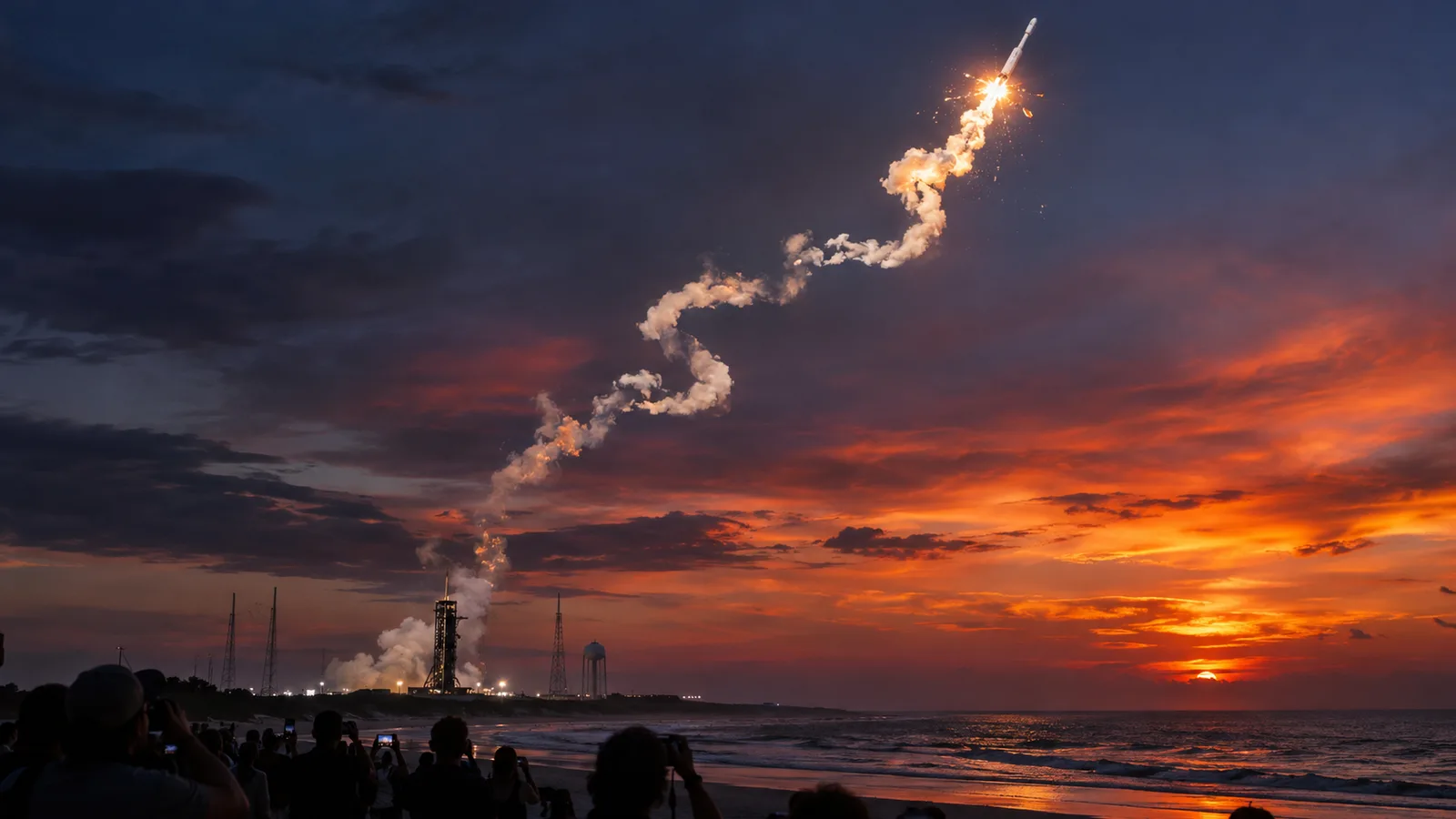
On Sunday, November 15, 2026, ULA's Vulcan rocket failed about 10 minutes after liftoff and lost all 40 Amazon Leo satellites on board. It was the first total mission failure in ULA's 20-year history. The bigger problem for Amazon: both rockets that carry most of its future launches, Vulcan and Blue Origin's New Glenn, are now grounded, and both use the same BE-4 engine. That leaves Ariane 6 and SpaceX's Falcon 9 as the only rides that work today.
- What was lost: 40 production Amazon Leo satellites on mission LV-01, the first of 38 Vulcan flights Amazon bought (Spaceflight Now).
- Where Amazon stands: 398 satellites in orbit, about 12% of the 3,236 it needs (Reuters via Stock Analysis).
- Starlink for comparison: 11,213 satellites in orbit as of November 16 (KeepTrack), a 28-to-1 lead.
- Our math: about 57% of Amazon's contracted launches ride on BE-4-powered rockets that are not flying right now.
- Winner: SpaceX, again. It is the most reliable launch provider for the Pentagon and, awkwardly, a key backup for its own biggest competitor.
What Happened on November 15
Vulcan lifted off from Space Launch Complex 41 at Cape Canaveral at 12:40 p.m. EST. It was Vulcan's fifth flight and its first in nine months, after a grounding over solid rocket booster nozzle problems. The six Northrop Grumman strap-on boosters appeared to work normally and separated about 1 minute 40 seconds into flight.
Then things went wrong. According to Spaceflight Now, the two BE-4 engines on the first stage appeared to fire longer than planned, and the Centaur V upper stage separated later than expected. Telemetry then showed unusual orientation changes early in the Centaur burn. About 50 minutes after liftoff, ULA confirmed the loss:
"Vulcan suffered an anomaly 10 minutes into the flight and failed to deliver the Amazon mission to orbit."
— ULA statement
ULA said it does not yet have "any specific data" on the cause, as The Next Web reports. Early sources quoted by Ars Technica point to the booster stage rather than the Centaur or the solids. Reuters noted it is still unclear whether Blue Origin's BE-4 engines played a role.
| Item | Detail |
|---|---|
| Date / time | November 15, 2026, 12:40 p.m. EST |
| Rocket | ULA Vulcan Centaur (VC6), flight 5 |
| Mission | Amazon Leo LV-01, 40 satellites |
| Failure point | About 10 minutes into flight, during the Centaur burn |
| ULA history | First total mission failure since 2006 |
| Vulcan status | Grounded pending investigation (months expected) |
| Amazon Leo in orbit | 398 of 3,236 planned |
👉 Takeaway: This was a return-to-flight mission. ULA needed a clean launch to restore trust with the Space Force and Amazon. It got the opposite.
The Real Problem: Amazon's Launch Plan Has a Single Point of Failure
Most coverage treats this as one lost batch of satellites. The bigger story is the shape of Amazon's launch contracts. Here is what Amazon has booked, based on Spaceflight Now's count:
| Rocket | Launches booked | Main engine | Status on Nov 16, 2026 |
|---|---|---|---|
| ULA Vulcan | 38 | Blue Origin BE-4 | Grounded after LV-01 failure |
| Blue Origin New Glenn | 24 | Blue Origin BE-4 | Grounded since May pad explosion; return pushed to January |
| Arianespace Ariane 6 | 24 | Vulcain 2.1 | Flying; next Leo launch NET Nov 23 (36 satellites) |
| SpaceX Falcon 9 | 13 (about 10 left) | Merlin | Flying |
| ULA Atlas V | 9 (8 flown) | RD-180 | Retiring |
Add it up and Amazon has about 108 launches on contract. 62 of them, or 57%, are on Vulcan and New Glenn. Both rockets are powered by the BE-4. New Glenn's May explosion was traced to an oxygen valve problem in a BE-4, and the engines on this Vulcan had been retrofitted with Blue Origin's fix.
If investigators find that the BE-4 played a role, the problem is not one rocket. It is the majority of Amazon's launch plan.
💡 Insight: Amazon chose to spread its launches across four companies to avoid depending on SpaceX. In practice, most of that "diversity" ran through one engine made by one company that Jeff Bezos also owns.
The Satellite Math: How Far Behind Is Amazon Leo?
Amazon needs 1,616 satellites (half of its 3,232-satellite first generation) to win back full spectrum priority from the FCC. The regulator already let Amazon miss its original July 30, 2026 deadline, but with a condition: satellites launched after that date lose the priority Amazon held, until it reaches the halfway mark or March 2028, as Yahoo News and SDxCentral explain. Amazon can win priority back as early as October 2027 if it proves the satellites are built and the launches are booked.
Here is our rough math:
- Gap to halfway: 1,616 − 398 = 1,218 satellites.
- Time to October 2027: about 11 months.
- Required pace: about 110 satellites a month, or roughly 3 Ariane 6 launches a month.
- Recent pace: about 330 satellites in orbit in early June and 398 now. That is roughly 13 a month.
Even before Sunday's failure, Amazon was launching at about one-eighth of the speed it needs. With Vulcan and New Glenn both down, the only near-term options are Ariane 6 (around 36 satellites per flight) and Falcon 9 (fewer per flight).
| Scenario for Amazon Leo | What it needs | Our view |
|---|---|---|
| Hit 1,616 by Oct 2027 | ~110 satellites a month from now | Very unlikely |
| Hit 1,616 by Mar 2028 | ~75 a month | Only if Vulcan and New Glenn both fly regularly by spring 2027 |
| Full 3,232 by July 2029 | ~90 a month for 32 months | Possible, but needs everything to work |
👉 Takeaway: Amazon Leo's problem was never money. It is launch capacity. Sunday made that problem bigger, not new.
Starlink vs Amazon Leo: The Gap Just Widened
The contrast with SpaceX is stark. Starlink has 11,213 satellites in orbit, 11,199 of them working, according to KeepTrack. SpaceX's IPO filing showed about 10.3 million paid subscribers in Q1 2026, roughly double a year earlier, and about $11.3 billion in connectivity revenue for 2025 (texxr, citing the S-1).
| Metric | Starlink | Amazon Leo |
|---|---|---|
| Satellites in orbit (Nov 2026) | 11,213 | 398 |
| Launch provider | Own rockets (Falcon 9, Starship) | Four outside providers |
| Paid customers | ~10.3M (Q1 2026) | Commercial service not yet broadly live |
| Launch status on Nov 16 | Flying several times a week | Two of four main rockets grounded |
| Next big step | Starship-launched V3 satellites | Ariane 6 launch NET Nov 23 |
Starlink also has a second engine of growth that Amazon does not. On November 13, Starship Flight 15 deployed 26 Starlink V3 satellites, and on November 14 SpaceX caught the ship with the tower for the first time. We covered that in our Starship Flight 15 analysis. A reusable Starship can carry far more satellites per flight than any rocket Amazon has access to.
💡 Insight: Vertical integration is the moat. SpaceX builds the satellites, the rockets and the ground network. Every launch delay Amazon suffers is a delay SpaceX simply does not have.
SpaceX: Winner, Backup Supplier and a Little Bit Awkward
Musk's public reaction was gracious. "Sorry to hear this. Hope you are back to flight soon," he wrote, as Yahoo Finance reports. Hours later he was back to needling Blue Origin, Boeing and Lockheed Martin: "Let's take this gentleman's argument at face value that anyone can throw money at rockets," he posted, arguing that money alone does not build a Starship (Stocktwits).
The business picture is clear:
- More Amazon business. Amazon already moved launches to SpaceX before. It asked the FCC for more time in January while it bought more SpaceX rides. Another order now looks likely.
- More Pentagon work. The Space Force had paused national security missions on Vulcan and was waiting on this flight to clear it. Ars Technica estimates Vulcan was due to carry about half of those missions in the next few years, with most of the rest going to SpaceX (The Next Web).
- Pricing power. SpaceX's Falcon 9 manifest is already full enough that it limited new commercial bookings beyond 2028 (Satnews). Scarce supply plus desperate buyers is a strong position for any seller.
There is a catch. SpaceX does not need to be generous to a competitor, and regulators know that. The FCC's whole approach to Amazon Leo is about keeping competition alive in low Earth orbit. A launch market where one company is both the leading satellite operator and the only reliable American rocket will draw more attention from Washington, not less.
SPCX shares rose nearly 1% overnight after the Starship catch and gained 3% last week, but are still down about 14% year to date (Yahoo Finance). For the full valuation picture, see our SpaceX stock (SPCX) forecast and the Starlink stock guide.
👉 Takeaway: The market already prices SpaceX as the launch leader. What changes is how long that lead lasts. Every month Vulcan and New Glenn stay down adds to it.
Who Wins and Who Loses
| Player | Impact | Why |
|---|---|---|
| SpaceX / SPCX | ✅ Wins | More Pentagon and Amazon demand, wider Starlink lead |
| Arianespace | ✅ Wins | The only flying non-SpaceX option for Amazon right now |
| Amazon / AMZN | ❌ Loses time | 40 satellites gone, two main rockets grounded, FCC priority at risk |
| ULA (Boeing + Lockheed Martin) | ❌ Loses | First failure ever, Space Force trust hit, Amazon's 38-launch deal under pressure |
| Blue Origin | ⚠️ At risk | If the BE-4 is involved, both its engine customers stall |
| U.S. Space Force | ⚠️ Mixed | Missions slip, and it becomes even more reliant on one supplier |
| Rural broadband buyers | ⚠️ Mixed | Real Starlink competition, and pressure on prices, comes later |
| Apple | ⚠️ Watch | Amazon bought Globalstar, Apple's satellite partner, for $11.57B; Leo delays touch that roadmap too (SDxCentral) |
Three Scenarios for the Next 12 Months
These are our editorial estimates, not forecasts from the companies.
- Quick fix (30%). The cause is a software or a one-off hardware issue in the Centaur. Vulcan returns by spring 2027. Amazon loses about four to six months.
- Long grounding (50%). The investigation takes most of 2027, as the booster nozzle probe did. Amazon leans on Ariane 6 and buys more Falcon 9 flights. Leo misses the October 2027 priority window.
- BE-4 problem (20%). Investigators link the failure to the engine. Both Vulcan and New Glenn slip deep into 2027. Amazon has to rethink its launch plan, which could even include Starship rides from SpaceX.
✔ What to watch: ULA's first findings, New Glenn's January return date, the Ariane 6 launch set for no earlier than November 23, and any new Amazon order with SpaceX.
How This Connects to Tesla and Optimus
SpaceX and Tesla are moving closer together, and we explained the details in our SpaceX–Tesla merger analysis. Starlink is the cash engine that funds much of that ecosystem, from AI compute to the $119 billion Terafab plan. A stronger, longer Starlink lead means more cash for Musk's AI and robotics bets, including Optimus. Investors tracking that chain can start with our Optimus stocks hub and the Starlink supply chain.
FAQ
Why did the Vulcan rocket fail?
ULA has not named a cause yet. The anomaly happened about 10 minutes into flight, during the Centaur upper stage burn, after the first stage seemed to fire longer than planned.
How many Amazon Leo satellites were lost?
All 40 satellites on mission LV-01 were lost. Amazon still has 398 satellites in orbit.
Is Amazon Leo delayed now?
Yes, in practice. Vulcan carried the largest block of Amazon's launches, and New Glenn is also grounded. The next Leo launch is on Ariane 6, no earlier than November 23.
Does this help SpaceX and SPCX stock?
It strengthens SpaceX's position as the most reliable launch provider and widens Starlink's lead. SPCX rose about 1% overnight after the Starship catch, but one event rarely moves a company this size much.
Can Amazon launch on SpaceX rockets?
Yes. Amazon has about 10 Falcon 9 launches left on contract and could buy more, although SpaceX's manifest is very busy.
Summary
Sunday's Vulcan failure cost Amazon 40 satellites, but the real damage is time. With Vulcan and New Glenn both on the ground, Amazon's plan to challenge Starlink depends on Ariane 6 and, ironically, SpaceX. Starlink already has a 28-to-1 lead in satellites and over 10 million paying customers. Unless ULA and Blue Origin recover fast, that gap will grow through 2027.
Want to follow the companies that benefit? Start with our SpaceX stock forecast and the Optimus stocks hub.
TRACKING THE MUSK ECOSYSTEM
We follow how SpaceX, Starlink, Tesla and Optimus connect, from rockets and satellites to the stocks they move.
